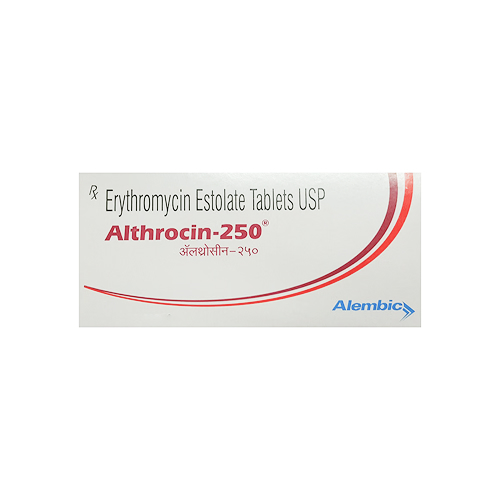
Images are for product identification. Refer to the selected batch for packaging and availability.
Althrocin 250 Tablet
Erythromycin (250mg)
YOUR PURCHASE PRICE
55 in stockInclusive of all taxes
Choose your batch
2 offersSign in to order for your pharmacy.
Product information
- Manufacturer
- Alembic Pharmaceuticals Limited
- Category
- Allopathy
- Composition
- Erythromycin (250mg)
- Packaging
- 10 TABLET
- Box / case pack
- 1 / —
Description
ALTHROCIN 250 TABLET
Althrocin 250 Tablet is an antibiotic medication manufactured by Alembic Pharmaceuticals Ltd., used to treat various bacterial infections.
-
Name:
- Brand Name: Althrocin 250 Tablet
- Common Name: Erythromycin (active ingredient)
-
Composition:
- Althrocin 250 Tablet contains Erythromycin 250 mg. Erythromycin is a macrolide antibiotic that works by inhibiting the growth of bacteria by preventing the synthesis of essential proteins required for their survival.
-
Uses: Althrocin 250 Tablet is prescribed for a wide range of bacterial infections, including:
- Respiratory tract infections: pneumonia, bronchitis, chest and lung infections, throat and sinus infections, Legionnaire's disease.
- Skin and tissue infections: acne, rosacea, impetigo, cellulitis.
- Ear, mouth, and dental infections.
- Eye infections.
- Sexually transmitted infections.
- Stomach and intestinal infections.
- It can also help prevent infections following burns, surgeries, or dental procedures.
-
Dosage and Administration:
- Take Althrocin 250 Tablet orally, exactly as prescribed by your doctor.
- It is generally recommended to take the tablet on an empty stomach, preferably at least one hour before or two hours after a meal, for optimal absorption.
- Swallow the tablet whole with water; do not chew or crush it.
- The dosage may vary based on age, weight, and the severity of the condition. Do not skip doses and complete the full course of treatment even if symptoms improve, to prevent the infection from returning or worsening.
-
Side Effects:
- Common Side Effects: Nausea, vomiting, abdominal pain, diarrhea, and loss of appetite. These are usually temporary.
- Serious Side Effects (seek immediate medical attention): Allergic reactions (swelling of lips, throat, or tongue, difficulty breathing, severe skin rashes, blistering), liver problems (jaundice, pale stools with dark urine), abnormal heart rhythms (QT prolongation), seizures, or severe bloody diarrhea.
-
Precautions:
- Inform your doctor about any allergies to erythromycin or other macrolide antibiotics.
- Exercise caution if you have liver problems, kidney disease, myasthenia gravis, heart rhythm disorders (QT prolongation), or electrolyte imbalances (low potassium or magnesium levels).
- Consult your doctor if you are pregnant, planning a pregnancy, or breastfeeding.
- Avoid alcohol consumption as it may reduce the effectiveness of the medicine.
- Do not take antacids 2 hours before or after taking Althrocin 250 Tablet.
-
Storage:
- Keep out of sight and reach of children.
- Store at room temperature.
Frequently asked questions
What is Althrocin 250 Tablet used for?
Althrocin 250 Tablet is an antibiotic medication used to prevent and treat a wide variety of bacterial infections throughout the body. It is effective against infections of the respiratory tract, including pneumonia, bronchitis, sinusitis, and Legionnaire's disease, as well as ear, mouth, dental, eye, skin, and tissue infections like acne and rosacea. It can also be used for stomach and intestinal infections, sexually transmitted infections, bone infections, and to prevent infections following burns, operations, or dental procedures.
How does Althrocin 250 Tablet work?
Althrocin 250 Tablet contains erythromycin, a macrolide antibiotic. It works by stopping the growth and reproduction of bacteria by interfering with their protein synthesis. Erythromycin binds to the 50S ribosomal subunit in bacterial cells, preventing them from producing essential proteins needed for their survival and growth, thereby clearing the infection.
What is the usual dosage of Althrocin 250 Tablet?
The dosage of Althrocin 250 Tablet is prescribed by your doctor and can vary based on your age, weight, and the severity of the infection. For adults, typical dosages range from 250 mg every 6 hours, 333 mg every 8 hours, or 500 mg every 12 hours. In severe infections, the dose may be increased up to 4 grams daily. It is generally recommended to take Althrocin 250 Tablet orally, preferably an hour before a meal or two hours after, as it is best absorbed on an empty stomach. Swallow the tablet whole with water without chewing or crushing it.
What are the possible side effects?
Common side effects include nausea, vomiting, abdominal pain, diarrhea, loss of appetite, and indigestion. These are usually temporary and tend to go away after treatment. More serious, but rare, side effects can include allergic reactions (such as swelling of the lips, throat, or tongue, difficulty breathing, or severe skin rashes), increased liver enzymes, hepatitis with or without jaundice, QT prolongation, and ventricular arrhythmias. If you experience severe diarrhea (watery or bloody), serious skin rashes with blistering, liver problems (yellowing of skin/eyes), seizures, or abnormal heart rhythms, seek immediate medical attention.
Is it safe during pregnancy or breastfeeding?
If you are pregnant or planning to become pregnant, consult your doctor before taking Althrocin 250 Tablet. It should be used during pregnancy only if clearly needed, as there is some evidence it may raise the chance of serious birth abnormalities in the early stages of pregnancy, though it is generally considered safe for bacterial infections. For breastfeeding women, Althrocin 250 Tablet should be used with caution and only if advised by a doctor, as small quantities of its components can pass into breast milk.
Can it be taken with other medications?
Althrocin 250 Tablet can interact with several other medications. It is crucial to inform your doctor about all medicines, supplements, and herbal products you are taking to avoid potential interactions. Some medications that may interact with Althrocin 250 Tablet include:
- Contraindicated Medications: Ergotamine and dihydroergotamine (for migraines), simvastatin (for cholesterol), tolterodine (for urinary disorders), amisulpride, domperidone, pimozide (for psychiatric/anti-emetic), astemizole, mizolastine, terfenadine (anti-allergics), and cisapride (for acid reflux). Combining these can lead to serious side effects like heart rhythm disturbances.
- Other interacting medications: Warfarin (blood thinner), theophylline (for asthma), quinidine, amiodarone, carbamazepine, cyclosporine, digoxin, and certain protease inhibitors.
What precautions should be taken?
- Complete the full course: Do not skip doses or stop taking the medicine prematurely, even if you feel better, as this can lead to the infection returning or bacteria developing resistance.
- Medical conditions: Inform your doctor if you have liver disease, kidney disease, heart problems (including QT prolongation or a family history of heart rhythm disorders), myasthenia gravis, or gastrointestinal disorders like colitis.
- Alcohol: It is generally recommended to avoid alcohol while taking Althrocin 250 Tablet, as it may reduce the medicine's effectiveness and can lead to adverse effects like dizziness.
- Antacids: Do not take antacids 2 hours before or after taking Althrocin 250 Tablet.
- Allergies: Do not take Althrocin 250 Tablet if you are allergic to erythromycin or other macrolide antibiotics like clarithromycin or azithromycin.
What happens if a dose is missed?
If you miss a dose of Althrocin 250 Tablet, take it as soon as you remember. However, if it is almost time for your next scheduled dose, skip the missed dose and continue with your regular dosing schedule. Do not double doses to make up for a missed one.
How should it be stored?
Store Althrocin 250 Tablet in a cool, dry place, away from direct sunlight and moisture. Keep the tablets out of reach of children and pets. Do not use the product after its expiry date and protect it from extreme heat or cold.