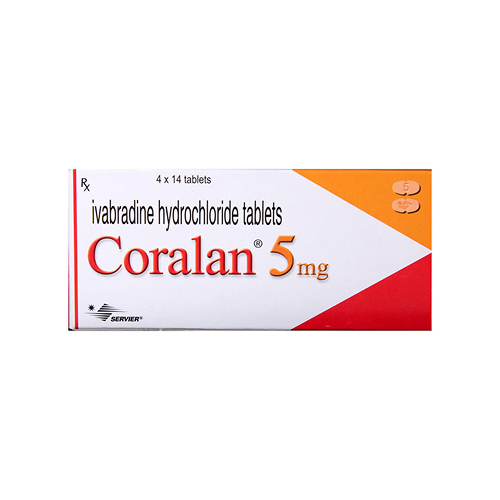
Images are for product identification. Refer to the selected batch for packaging and availability.
Coralan 5- 14 Tab
Ivabradine (5mg)
YOUR PURCHASE PRICE
15 in stockInclusive of all taxes
Choose your batch
2 offersSign in to order for your pharmacy.
Product information
- Manufacturer
- Serdia Pharmaceuticals (india) Pvt. Ltd.
- Category
- Allopathy
- Composition
- Ivabradine (5mg)
- Packaging
- 14 TABLET
- Box / case pack
- 1 / —
Description
CORALAN 5mg is a medication primarily used for managing chronic stable angina and chronic heart failure. It works by specifically slowing the heart rate, which reduces the heart's workload and oxygen demand, thereby improving cardiac efficiency.
-
Name
- Common Name: Ivabradine
- Brand Name: CORALAN (also known as Corlanor in some regions)
-
Composition
- Active Ingredient: Each CORALAN 5mg tablet contains 5mg of ivabradine (as the hydrochloride salt).
- Inactive Ingredients: Include lactose monohydrate, magnesium stearate, maize starch, maltodextrin, colloidal anhydrous silica, hypromellose, titanium dioxide (E 171), macrogol 6000, glycerol, yellow iron oxide (E 172), and red iron oxide (E 172).
-
Uses CORALAN is prescribed for:
- Symptomatic treatment of chronic stable angina pectoris in adults with normal sinus rhythm and a heart rate of 70 beats per minute (bpm) or more, particularly when beta-blockers are contraindicated, not tolerated, or provide inadequate control.
- Chronic heart failure in adult patients with symptomatic heart failure, reduced ejection fraction, and a heart rate of 70 bpm or more, who are in sinus rhythm and cannot take beta-blockers or are already on a maximally tolerated dose.
-
Dosage and Administration
- Typically taken orally twice daily (morning and evening) with meals.
- Starting Dose: For both stable angina and heart failure, the usual starting dose is 5 mg twice daily.
- Adjustment: After 2-4 weeks, the dose may be adjusted based on heart rate and symptomatic response, but should not exceed 7.5 mg twice daily.
- Elderly (≥75 years): A lower starting dose of 2.5 mg twice daily (half of a 5mg tablet) may be considered.
- Treatment should be discontinued if heart rate remains persistently below 50 bpm or symptoms of bradycardia persist despite dose reduction.
-
Side Effects
- Common: Temporary visual disturbances (luminous visual phenomena like bright spots, halos, coloured flashes, or distorted images, often within the first two months), slow heartbeat (bradycardia), headache, dizziness, increased blood pressure, atrial fibrillation, nausea, abdominal pain, and diarrhoea.
- Serious (rare): Difficulty breathing, swelling of the face, lips, mouth, tongue or throat, severe skin rash, changes in heart rate (fast or irregular), or fainting. Seek immediate medical attention if these occur.
-
Precautions
- Contraindicated in patients with severe liver problems, very low blood pressure, certain heart rhythm disorders (e.g., sick sinus syndrome, 3rd-degree AV block, pacemaker dependence), unstable angina, acute heart failure, pregnancy, or breastfeeding.
- Avoid consuming grapefruit juice while on CORALAN.
- Concomitant use with diltiazem or verapamil is not recommended.
- May cause dizziness or visual symptoms; exercise caution when driving or operating machinery.
- Not recommended for individuals under 18 years of age.
-
Storage
- Keep CORALAN tablets in their original blister pack, protected from moisture and heat, at a temperature below 30°C.
- Store in a cool, dry place, out of reach and sight of children.
Frequently asked questions
What is CORALAN used for?
CORALAN (ivabradine) is primarily used to treat adults with chronic heart failure to reduce their risk of hospitalization for worsening heart failure. It is also prescribed for the symptomatic management of chronic stable angina (heart-related chest pain) in adults. For children aged 6 months and older with stable heart failure due to an enlarged heart (dilated cardiomyopathy), CORALAN may also be used.
How does CORALAN work?
CORALAN works by selectively slowing the heart rate. Its active ingredient, ivabradine, targets and inhibits a specific electrical current in the heart's natural pacemaker (the sinoatrial node), known as the "funny" (I_f) channel. This action reduces the heart rate, which in turn allows the heart more time to fill with blood and pump it more efficiently throughout the body. This helps to reduce the heart's workload and improve cardiac function without significantly affecting myocardial contractility or blood pressure.
What is the usual dosage of CORALAN?
For adults, the typical starting dose of CORALAN is 5 mg taken twice daily with food. Your doctor may adjust this dose after two weeks based on your resting heart rate and how well you tolerate the medication, aiming for a resting heart rate between 50 and 60 beats per minute (bpm). The maximum recommended dose is 7.5 mg twice daily.
For pediatric patients aged 6 months and older, the dosage depends on body weight. For those weighing less than 40 kg, the initial dose is 0.05 mg/kg twice daily with food. For children weighing 40 kg or more, the initial dose is 2.5 mg orally twice daily with food. Doses are adjusted at two-week intervals based on tolerability and to achieve a target heart rate reduction. The maximum dose for children 6 months to less than 1 year old is 0.2 mg/kg twice daily, and for children 1 year and older, it is 0.3 mg/kg twice daily, not exceeding a total of 7.5 mg twice daily.
What are the possible side effects of CORALAN?
Common side effects of CORALAN include luminous phenomena (temporary visual brightness or flashes of light, halos, or colored flashes), slow heartbeat (bradycardia), headache, dizziness, blurred vision, and increased blood pressure. Other reported side effects include atrial fibrillation (an irregular heartbeat), nausea, constipation, diarrhea, and fatigue. Some side effects, such as very slow heartbeat or significant changes in heart rhythm, can be serious and may require urgent medical attention.
Is CORALAN safe during pregnancy or breastfeeding?
CORALAN is generally not recommended during pregnancy and is considered contraindicated due to potential risks of fetal harm, including cardiac malformations, observed in animal studies. Females of childbearing potential should use effective contraception while taking CORALAN. It is also not recommended during breastfeeding, as it is unknown whether the medication passes into breast milk and could affect the nursing infant.
Can CORALAN be taken with other medications?
CORALAN can interact with several medications. It should not be taken with potent CYP3A4 inhibitors, such as certain antifungal medications (e.g., ketoconazole, itraconazole), some macrolide antibiotics (e.g., clarithromycin), HIV protease inhibitors (e.g., nelfinavir, ritonavir), and the antidepressant nefazodone. Additionally, it should not be used with heart rate-reducing calcium channel blockers like verapamil or diltiazem. Concurrent use with other drugs that slow the heart rate (e.g., beta-blockers, digoxin, amiodarone) should be done with caution and under close monitoring, as it can increase the risk of bradycardia. Grapefruit juice should also be avoided while taking CORALAN.
What precautions should be taken while using CORALAN?
It's important to have your heart rate and rhythm monitored regularly by your doctor while taking CORALAN, especially for bradycardia and atrial fibrillation. You should also be aware of potential vision changes, such as temporary bright spots or flashes, and exercise caution when driving or operating machinery, particularly in situations with sudden changes in light intensity. Patients with severe liver impairment, unstable angina, severe low blood pressure, or certain heart conduction abnormalities (e.g., sick sinus syndrome, third-degree AV block, unless a pacemaker is present) should not use CORALAN. Avoid consuming grapefruit juice.
What happens if a dose of CORALAN is missed?
If you miss a dose of CORALAN, do not take an extra dose to make up for the missed one. Simply take your next dose at the regularly scheduled time.
How should CORALAN be stored?
CORALAN tablets should be stored at room temperature, typically between 20°C to 25°C (68°F to 77°F). Keep the medicine in its original blister pack, away from direct light, moisture, and heat. Do not store it in the refrigerator or freezer. Always keep CORALAN out of the reach and sight of children.