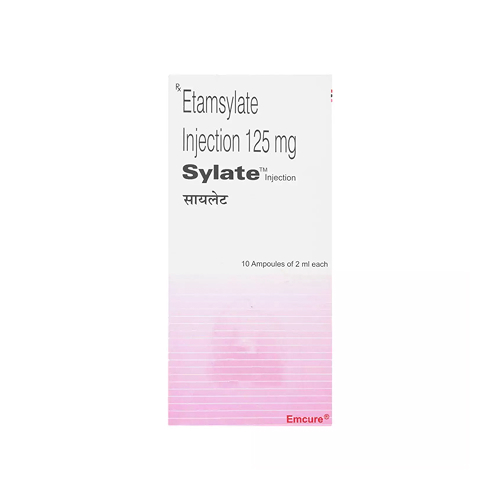
Images are for product identification. Refer to the selected batch for packaging and availability.
Sylate Injection
Ethamsylate (125mg)
YOUR PURCHASE PRICE
3 in stockInclusive of all taxes
Available batch
1 offerSign in to order for your pharmacy.
Product information
- Manufacturer
- Emcure Pharmaceuticals Ltd
- Category
- Allopathy
- Composition
- Ethamsylate (125mg)
- Packaging
- 2 ML
- Box / case pack
- 1 / —
Description
SYLATE INJECTION
SYLATE INJECTION is a hemostatic medication manufactured by Emcure Pharmaceuticals Ltd., primarily used to manage and prevent bleeding from small blood vessels.
Composition
- Active Ingredient: Ethamsylate. SYLATE INJECTION is a sterile solution containing Ethamsylate, commonly supplied in strengths such as 125 mg/mL or 250 mg/mL.
Uses
SYLATE INJECTION is indicated for the prevention and treatment of hemorrhagic conditions. It works by enhancing platelet adhesion and strengthening capillary walls to reduce bleeding time and blood loss. It is prescribed for:
- Heavy menstrual bleeding (menorrhagia) and dysfunctional uterine bleeding.
- Postpartum hemorrhage and post-abortion bleeding.
- Bleeding associated with dental extractions, surgical procedures, and traumatic injuries.
- Prevention of periventricular-intraventricular hemorrhage in premature infants.
- Other conditions involving capillary bleeding like melena, hematuria, epistaxis, and secondary bleeding due to low platelet count.
Dosage and Administration
SYLATE INJECTION is administered intravenously (IV) or intramuscularly (IM). The dosage and frequency depend on the severity of bleeding and the patient's response, and should be determined by a healthcare professional.
- Preoperative: Typically 250-500 mg given one hour prior to surgery. Additional doses may be required during the operation.
- Postoperative: 250 mg twice daily, or up to 250-500 mg every 4-6 hours as long as bleeding risk persists.
- Menorrhagia: Often 500 mg three to four times daily during menstruation, starting 5 days before onset or when bleeding begins.
- Neonates: 12.5 mg/kg IV every 6 hours.
Side Effects
Common side effects may include:
- Headache, dizziness
- Nausea, vomiting, stomach pain/discomfort, diarrhea
- Skin rash, allergic reactions
- Weakness, injection site reactions (pain, swelling, redness) Serious adverse reactions, though rare, can include severe allergic reactions or thromboembolic events such as deep vein thrombosis or pulmonary embolism.
Precautions
- Contraindications: Do not use if allergic to Ethamsylate or any component of the formulation. It is also contraindicated in individuals with thromboembolic disorders, a history of arterial or venous thrombosis, porphyria, or bronchial asthma.
- Medical Conditions: Use with caution in patients with renal impairment or a history of peptic ulcer disease.
- Drug Interactions: May potentiate the effects of anticoagulant medications or other drugs that affect platelet function; use with caution.
- Specific Populations: Safety and efficacy have not been established in pediatric patients, pregnant women, and nursing mothers. Consult a healthcare professional before administering to these populations.
Storage
SYLATE INJECTION should be stored at controlled room temperature (20°C to 25°C), away from light and moisture. It is a single-use solution, and any unused portion must be discarded according to standard procedures. Keep out of sight and reach of children.
Frequently asked questions
What is SYLATE INJECTION used for?
SYLATE INJECTION, which contains Ethamsylate as its active ingredient, is primarily used to control and prevent bleeding from small blood vessels (capillaries). It is commonly prescribed for conditions such as heavy menstrual bleeding (menorrhagia) and dysfunctional uterine bleeding. It also helps in preventing or reducing excessive bleeding during or after delicate surgical procedures and can be used to prevent brain hemorrhage in newborn babies.
How does SYLATE INJECTION work?
SYLATE INJECTION is a hemostatic agent. It works by enhancing the ability of platelets to stick together (improving platelet adhesion) and strengthening the walls of capillaries. This action helps to reduce bleeding time, increase platelet clumping, and promote the formation of blood clots, thereby controlling blood loss from small vessels. It also inhibits the biosynthesis and action of certain prostaglandins involved in bleeding.
What is the usual dosage of SYLATE INJECTION?
The dosage of SYLATE INJECTION is determined by a healthcare professional based on the specific bleeding condition and the patient's response. It is typically administered intravenously (into a vein) or intramuscularly (into a muscle) by a healthcare provider. For conditions like post-operative hemorrhage, a common dosage might be 250-500 mg every 4-6 hours as needed to control bleeding. In neonates, for prevention of periventricular hemorrhage, a dose of 12.5 mg/kg intravenously every 6 hours may be prescribed.
What are the possible side effects of SYLATE INJECTION?
Common side effects of SYLATE INJECTION include headache, skin rashes, nausea, vomiting, diarrhea, abdominal discomfort or stomach pain, weakness, and reactions at the injection site such as pain, swelling, or redness. While generally mild and temporary, if any side effects persist or worsen, it's important to consult your doctor. Rarely, severe allergic reactions or the development of blood clots can occur, requiring immediate medical attention.
Is SYLATE INJECTION safe during pregnancy or breastfeeding?
Pregnancy: SYLATE INJECTION is generally not recommended during pregnancy as there is limited safety information available. It should be used with caution, and only if clearly prescribed by a doctor after evaluating the benefits against potential risks.
Breastfeeding: SYLATE INJECTION is generally not recommended for use by breastfeeding women. It is unknown if the medicine is excreted in breast milk, and limited safety information exists regarding its effects on nursing infants.
Can SYLATE INJECTION be taken with other medications?
You should inform your doctor about all other medications, supplements, and herbal products you are currently taking to avoid potential interactions. SYLATE INJECTION should generally not be taken with solutions containing sodium bicarbonate, compound sodium lactate, and thiamine (vitamin B1), as these may alter its effectiveness. Caution is also advised if taken with anticoagulants (blood thinners) like warfarin, as this combination could increase the risk of excessive bleeding.
What precautions should be taken with SYLATE INJECTION?
SYLATE INJECTION should not be used if you have a known allergy to Ethamsylate or similar medicines. It is contraindicated in patients with porphyria (a blood disorder), liver or kidney dysfunction, low or unstable blood pressure, or bronchial asthma. It should also be avoided by individuals with a history of thrombosis or clotting disorders. In newborns, treatment should be discontinued if a fever develops. Your doctor will assess your medical history and current conditions before prescribing this medication.
What happens if a dose of SYLATE INJECTION is missed?
Since SYLATE INJECTION is administered by a healthcare professional in a hospital or clinic setting, the likelihood of missing a dose is generally low. However, if a scheduled dose is missed, it should be administered as soon as it is remembered. If it is almost time for the next dose, the missed dose should be skipped, and the regular dosing schedule should be continued. It is important not to take a double dose to compensate for a missed one.
How should SYLATE INJECTION be stored?
SYLATE INJECTION should be stored in a cool, dry place, protected from direct heat and light. It is typically stored at temperatures below 30°C. Keep this medicine out of the sight and reach of children.