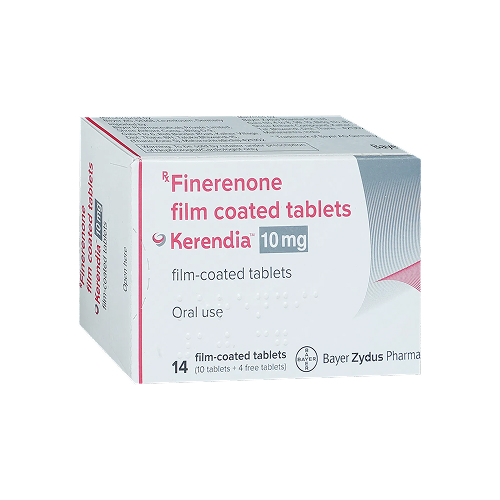
Images are for product identification. Refer to the selected batch for packaging and availability.
Kerendia 10 Mg Tablet (10 Tab + 4 Free Tab)
Finerenone (10mg)
YOUR PURCHASE PRICE
19 in stockInclusive of all taxes
Choose your batch
2 offersSign in to order for your pharmacy.
Product information
- Manufacturer
- Bayer Zydus Pharma Pvt. Ltd.
- Category
- Allopathy
- Composition
- Finerenone (10mg)
- Packaging
- 14 TABLET
- Box / case pack
- 1 / —
Description
KERENDIA 10 MG TABLET
KERENDIA is a prescription medication used to address chronic kidney disease (CKD) associated with type 2 diabetes (T2D) and certain forms of heart failure.
Name
- Brand Name: KERENDIA
- Common Name: Finerenone
Composition
- Active Ingredient: Each film-coated tablet contains 10 mg of Finerenone.
- Other Ingredients: Lactose monohydrate, cellulose microcrystalline, croscarmellose sodium, hypromellose, magnesium stearate, sodium lauryl sulfate. The film coating also contains hypromellose, titanium dioxide, talc, and ferric oxide red.
Uses
KERENDIA is prescribed to reduce the risk of:
- Sustained decline in kidney function, end-stage kidney disease, and cardiovascular death in adults with CKD associated with T2D.
- Non-fatal myocardial infarction (heart attack) and hospitalization for heart failure in adults with CKD associated with T2D.
- Cardiovascular death, hospitalization for heart failure, and urgent heart failure visits in adults with heart failure with left ventricular ejection fraction (LVEF) ≥40%.
Dosage and Administration
KERENDIA tablets are taken once daily by mouth, with or without food, preferably around the same time each day. The starting dose (10 mg or 20 mg) is determined by your doctor based on your estimated glomerular filtration rate (eGFR) and serum potassium levels. Serum potassium and eGFR should be measured before initiation, 4 weeks after starting, and periodically throughout treatment. If a dose is missed, it should be taken as soon as remembered on the same day; do not take two doses to compensate for a missed dose. Tablets can be crushed and mixed with water or soft foods if swallowing whole is difficult.
Side Effects
Common side effects include:
- High potassium levels (hyperkalemia).
- Low blood pressure (hypotension).
- Low sodium levels (hyponatremia).
- High uric acid levels.
- Weakness or tiredness.
- Nausea.
Serious side effects can include worsening kidney function in patients with heart failure.
Precautions
- Do not initiate treatment if serum potassium is above 5.0 mmol/L.
- Avoid consuming grapefruit or grapefruit juice, as it can increase finerenone levels.
- Concomitant use with strong CYP3A4 inhibitors is contraindicated.
- Caution is advised in patients with liver impairment.
- Not recommended during pregnancy unless clearly necessary, and breastfeeding should be avoided during treatment and for 1 day after.
- Inform your doctor about all other medications, supplements, and herbal products you are taking, especially potassium supplements and other blood pressure or heart medications.
Storage
Store KERENDIA tablets at 20°C to 25°C (68°F to 77°F), with excursions permitted between 15°C to 30°C (59°F to 86°F). Keep out of sight and reach of children.
Frequently asked questions
What is KERENDIA 10 MG TABLET used for?
KERENDIA (finerenone) 10 mg tablet is primarily used to reduce the risk of various complications in adults with chronic kidney disease (CKD) associated with type 2 diabetes (T2D). These complications include the worsening of kidney disease, progression to end-stage kidney disease, cardiovascular death, heart attack, and hospitalization for heart failure. It can also be used to reduce the risk of cardiovascular death, hospitalization for heart failure, and urgent heart failure visits in adults with heart failure with left ventricular ejection fraction (HF LVEF) ≥40%.
How does KERENDIA work?
KERENDIA contains the active substance finerenone, which is a nonsteroidal, selective mineralocorticoid receptor (MR) antagonist. It works by blocking the overactivation of mineralocorticoid receptors in the kidneys, heart, and blood vessels. Overactive MRs are thought to contribute to inflammation, tissue damage, and scarring, which can worsen kidney and cardiovascular disease. By blocking these receptors, KERENDIA helps to reduce inflammation and fibrosis, slow the progression of CKD, and lower the risk of heart-related issues.
What is the usual dosage of KERENDIA 10 MG TABLET?
KERENDIA is typically taken once daily by mouth, with or without food. The starting dose depends on your kidney function, as determined by your estimated glomerular filtration rate (eGFR).
- If your eGFR is at least 60 mL/min/1.73 m², the usual starting dose is 20 mg once daily.
- If your eGFR is between 25 and less than 60 mL/min/1.73 m², the usual starting dose is 10 mg once daily.
- Initiation of KERENDIA is generally not recommended if your eGFR is less than 25 mL/min/1.73 m².
Your doctor will monitor your serum potassium and eGFR levels 4 weeks after starting treatment or any dose adjustment, and periodically throughout treatment, to adjust the dose as needed. The maximum recommended daily dose is 20 mg. If you are unable to swallow the tablet whole, it can be crushed and mixed with water or soft foods like applesauce and taken immediately.
What are the possible side effects of KERENDIA?
Common side effects of KERENDIA may include:
- High potassium levels (hyperkalemia), which can be serious and, in rare cases, life-threatening. Symptoms can include nausea, weakness, tingly feeling, chest pain, irregular heartbeats, or loss of movement.
- Low blood pressure (hypotension). Symptoms may include dizziness, blurred vision, confusion, lightheadedness, or tiredness.
- Low blood sodium levels (hyponatremia). Symptoms can include headache, confusion, problems with thinking or memory, weakness, or feeling unsteady.
- High uric acid levels.
Serious but less common side effects can include severe allergic reactions. If you experience any severe or concerning side effects, contact your doctor immediately.
Is KERENDIA safe during pregnancy or breastfeeding?
KERENDIA should generally not be used during pregnancy unless your doctor determines it is clearly necessary, as animal studies have shown potential risks to the fetus. Women of childbearing potential should use effective contraception during treatment.
Breastfeeding is not recommended during treatment with KERENDIA and for at least 1 day after the last dose, due to the potential risk to the breastfed infant.
Can KERENDIA be taken with other medications?
KERENDIA can interact with several other medications, supplements, and foods.
- Avoid taking KERENDIA with strong or moderate CYP3A4 inhibitors (e.g., itraconazole, clarithromycin, ketoconazole, ritonavir, telithromycin, nefazodone), as this can significantly increase the levels of finerenone in your blood and increase the risk of side effects.
- Avoid concomitant use with strong or moderate CYP3A4 inducers (e.g., rifampicin, carbamazepine, phenytoin, phenobarbital, St. John's wort), as these can decrease the effectiveness of KERENDIA.
- Avoid grapefruit or grapefruit juice during treatment with KERENDIA, as it can cause a dangerous increase in the medication's blood levels.
- Use caution and monitor serum potassium more frequently if taking medications that increase potassium levels, such as potassium-sparing diuretics (e.g., amiloride, triamterene, spironolactone, eplerenone), other mineralocorticoid receptor antagonists, potassium supplements, or trimethoprim/sulfamethoxazole.
- Your doctor may also monitor your blood pressure if you are taking multiple other antihypertensive medications.
Always inform your doctor about all prescription and over-the-counter medicines, vitamins, minerals, herbal products, and other supplements you are currently using.
What precautions should be taken?
Before starting KERENDIA, discuss your full medical history with your doctor.
- Hyperkalemia (high potassium levels): KERENDIA can cause high potassium levels, which can be serious. Your doctor will monitor your potassium levels before and during treatment, especially if you have reduced kidney function or already high potassium levels.
- Kidney or Liver Problems: KERENDIA is not recommended for initiation in patients with severe kidney impairment (eGFR < 25 mL/min/1.73 m²) or severe liver impairment (Child-Pugh C). Additional potassium monitoring may be needed in patients with moderate liver impairment (Child-Pugh B).
- Adrenal Insufficiency: Patients with adrenal insufficiency should not take KERENDIA.
Regular blood tests are important to check for potassium levels and kidney function.
What happens if a dose is missed?
If you miss a dose of KERENDIA, take it as soon as you remember, but only on the same day. If you don't remember until the next day, skip the missed dose and continue with your regular schedule. Do not take two doses to make up for a missed dose.
How should it be stored?
KERENDIA tablets should be stored at room temperature, ideally between 20°C to 25°C (68°F to 77°F). Brief excursions between 15°C to 30°C (59°F to 86°F) are permitted. Store in a cool, dry place and keep out of reach of children.